BIGGLES IN THE BALTIC
Book First Published in June 1940 - 256 pages
This story was first published, in eleven weekly parts, as
STORM-TROOP OF THE BALTIC SKIES in The War Thriller issues 579 to 589, dated 9th March
1940 to 18th May 1940
This book MUST have been written after
“Biggles in the South Seas” although it was published in book form three months
before that book. “Biggles in the
Baltic” starts with the announcement of war with Germany, an event which
occurred on 3rd September 1939.
Johns
must have written that book on or after that date. There is no way that he could have written
“Baltic” AND then written “South Seas” and had “South Seas” typeset and ready
for publication in “The Gem” on 14th October 1939.
I
imagine that the publishers wanted to get a “Second World War” story out as
soon as possible. The original first
edition of “Biggles in the Baltic” is subtitled “A Tale of the Second Great
War”.
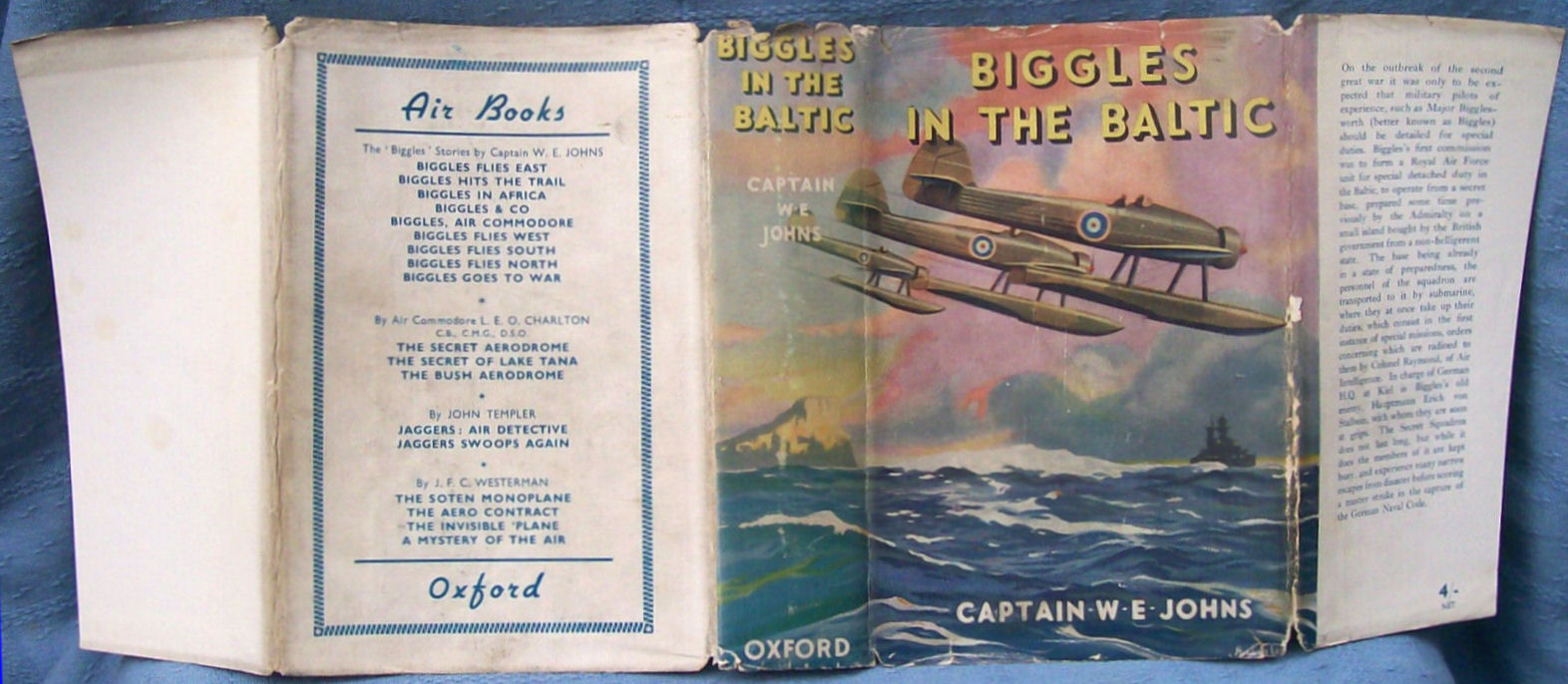
This is the original first edition dust jacket. Note the back panel printed with blue
ink. The original price was 4 shillings.
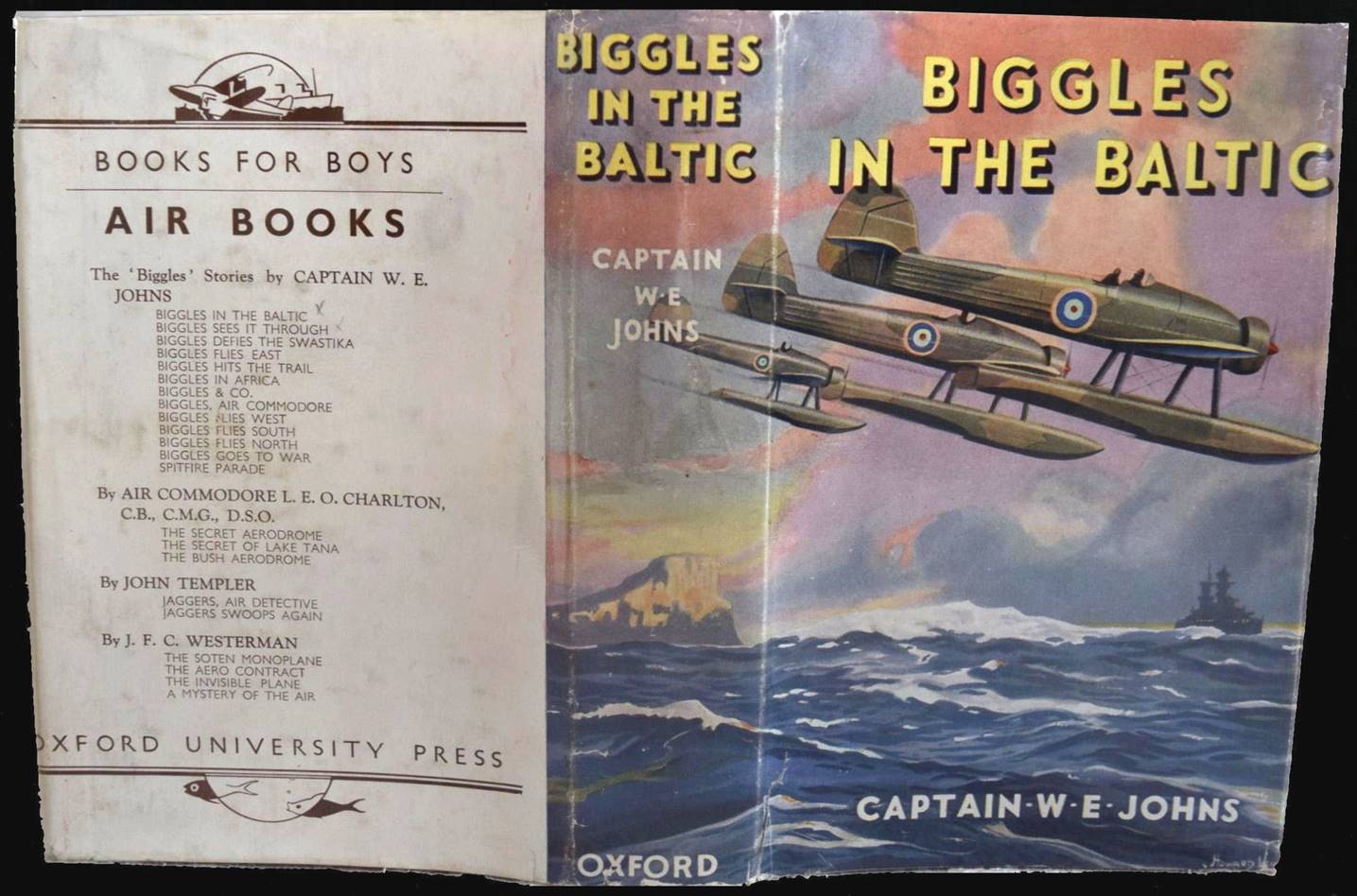
Above is the dust jacket from the 1941 second edition. This was a thinner book. It has a different design of back panel and
the lettering is in brown ink rather than blue.
There were two different publishers of editions published in
1941. I suspect this is probably from
the 1941 edition published by “John Johnson” at the University Press, Oxford.
There appears to be two different editions of this book published
by “John Johnson” – one is said to be 37 mm thick and one 32 mm thick. I only have the 32 mm one.
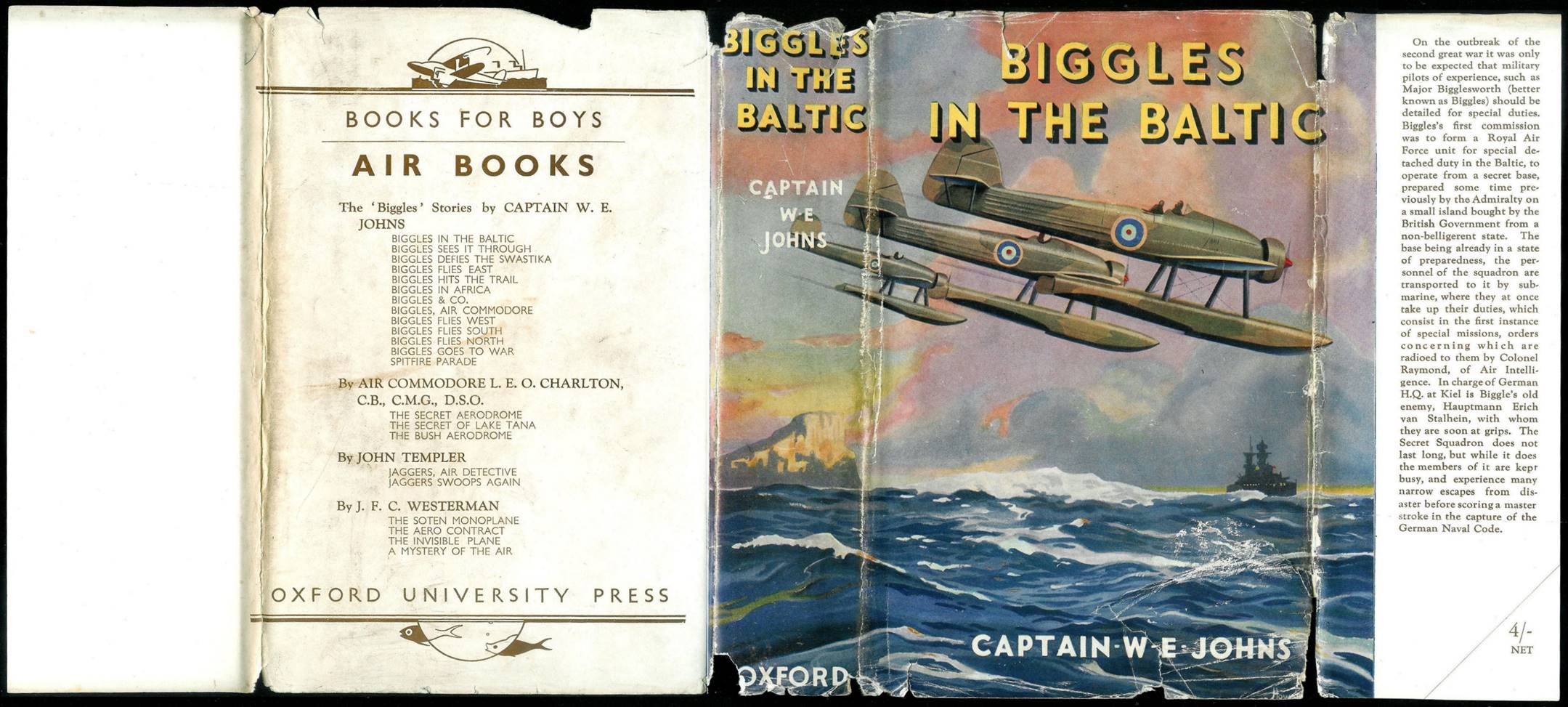
This is the dust wrapper for a 1941 edition from my own
collection. This book was published by
“J and J Gray, Edinburgh” rather than “John Johnson”. Priced at 4 shillings.
The spine of this dust jacket is slightly thinner than the other
1941 book above – note how the “roundel” on the third smaller aircraft is on
the cover here but on the spine of the book above.
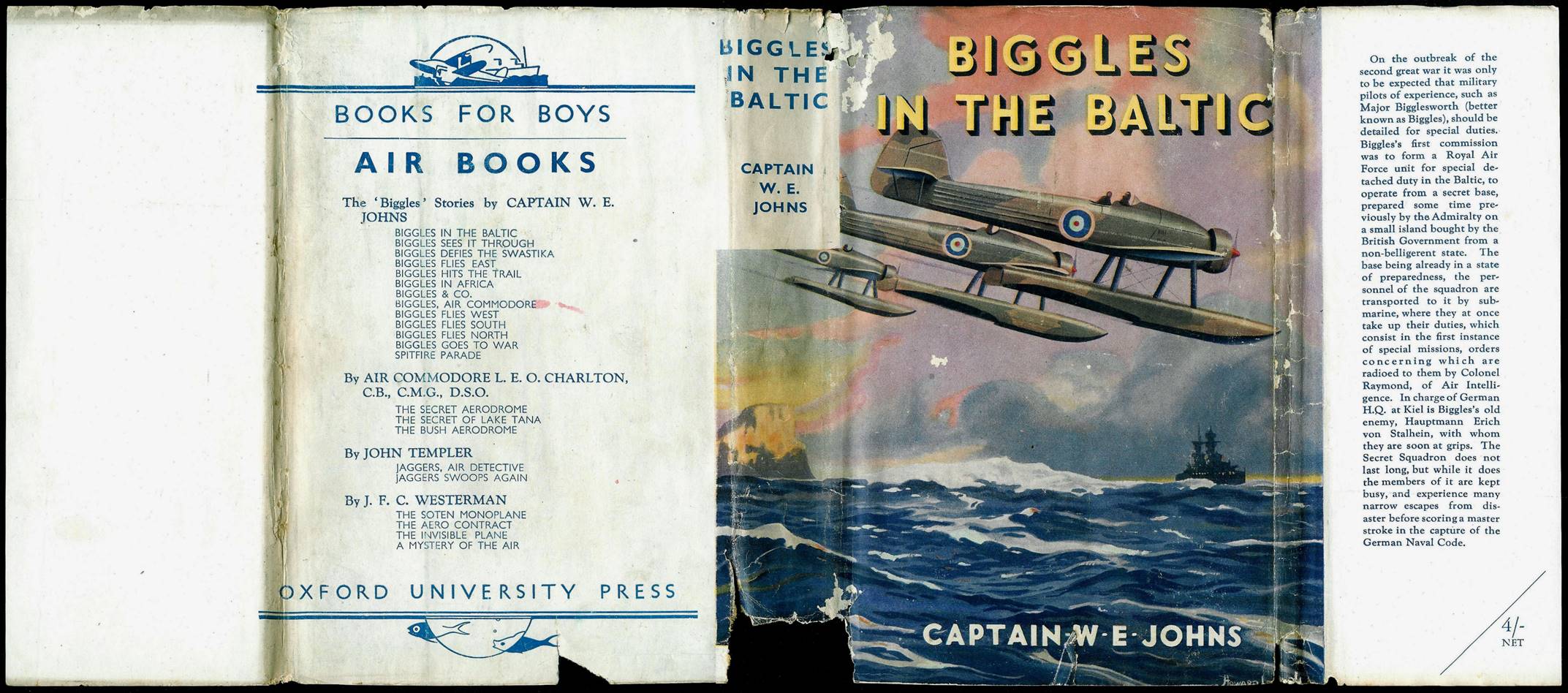
This is the dust jacket for the “thin” edition - priced 4
shillings. Although the books are dated
1940, this was published later – I suspect 1942. They merely used the first edition printing
plates.
It has “Spitfire Parade” (August 1941) on the back, so can’t be
from 1940. The 1941 second editions were
much thicker. Books got thinner as WWII
progressed, due to paper shortages.
Note how the cover painting had to be overlaid with a white patch,
covering the original title and author’s name, so a much smaller title and
author’s name could fit on the thinner spine.
CHAPTERS
Click on any chapter for a summary of the events in that chapter or
see the general story summary below
As the
momentous words "England is now, therefore, in a state of war with
Germany" came sombrely over the radio, Biggles knows that they are all in
for another spot of war flying. Almost immediately Air Commodore Raymond is in
touch. He is back at his old job in Air Intelligence and has a proposal for
Biggles. Britain has purchased from a neutral country a small island called
Bergen Ait in the Baltic Sea, which has a huge cave inside. This has already
been fitted out as an air base and fully stocked with supplies. Biggles, Algy
and Ginger, together with Flight Sergeant Smyth, his son Roy (as wireless
operator) and Raymond's old cook William Salt (known as 'Briny'), form 'Z'
Squadron and are taken to the Baltic island by submarine. Their four aircraft
are already there and are all given Australian names as they intend to strike
and return like Boomerangs. Ginger's is called Dingo, Algy goes for Didgeree-du and Biggles calls his aircraft Willie-Willie.
The fourth plane, a spare, is named the Duck-billed platypus. Various
dangerous missions take place. A German U-boat, U159, arrives and has to be
quickly sunk before it can give away the position of their base. This has a
particularly fortunate side effect when the German codebook is washed ashore
amongst the debris. A German Dornier flying boat follows and has to be shot
down, but not before Ginger's plane is hit. Ginger lands in the sea and Biggles
lands to pick him up. The Dingo is set alight in order to destroy it.
Weather conditions prevent them all from returning to their base and so both
Algy and Biggles, with Ginger on board, fly to the first available land, which
is a sandbank. They soon discover they are on German soil and find the German
liner Leipzig, now being used as a troop ship, hidden in a channel. When
the weather improves they all return to Bergen Ait but find that Briny has
disappeared. Convinced that our heroes were down on the water he had set off in
a boat to look for them. The following day, Biggles and Algy split up and set
off to look for Briny. Algy finds Briny stranded on the same sandbank they had
previously landed on, whilst Biggles separately finds his boat by a neutral
ship. Landing, Biggles is captured by none other than Erich von Stalhein
himself, who is flying a false flag. Biggles' aircraft is destroyed and Algy
later finds the wreckage. Meanwhile Ginger goes exploring a cave at the back of
their island base and finds himself stranded at the top of the island. Biggles
is taken to the Leipzig and tried and sentenced to be shot. He is saved
when Algy torpedoes the Leipzig. Biggles swims back to the sandbank
where he unexpectedly meets Algy who has come to blow up a German supply depot
there. An exhausted Biggles is returned to Bergen Ait where Algy leaves him to
sleep whilst he, Algy, continues with the destruction of the depot. Biggles
wakes up to find von Stalhein standing over him! The Germans have found and
taken their base! Algy returns and is forced to land on top of the island where
he meets up with Ginger. Smyth, Briny and Roy have all taken refuge in the cave
at the back of the base, which leads them eventually to Ginger and Algy. Ginger
returns to the base in time to see Biggles about to be shot and manages to open
fire and get him away. Our heroes are reunited. Biggles blows up an underground
lake in order to destroy their base and wash away the Germans. Algy tries to
take off but crashes in the sea. A British submarine arrives in order to
collect the German codebook and this is enough to see the remaining Germans
off. Algy then uses a captured German flying boat to drop parachutes to our
heroes stranded at the top of the island after the explosion. They use these to
jump off and are collected from the sea by Algy who then flies them all home to
England.
Click here to see the story illustrations from the original HARDBACK first edition of this book
Click here to see different illustrations from a Dutch version of this book
Biggles in the Baltic
Publication Details - published by Oxford University Press
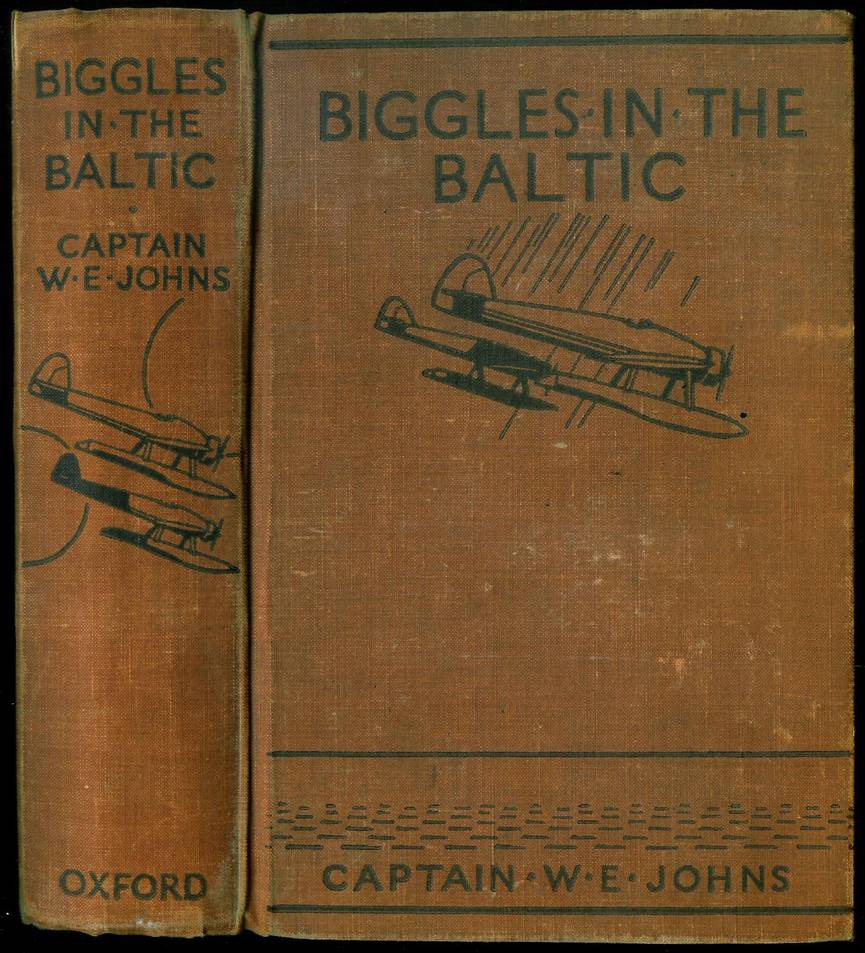
The spine and cover illustrations from the original Oxford first
edition
The first edition of this book has an asterisk * on the title
page. This normally denotes a reprint
but in this case, uniquely, it is the first edition that has it.
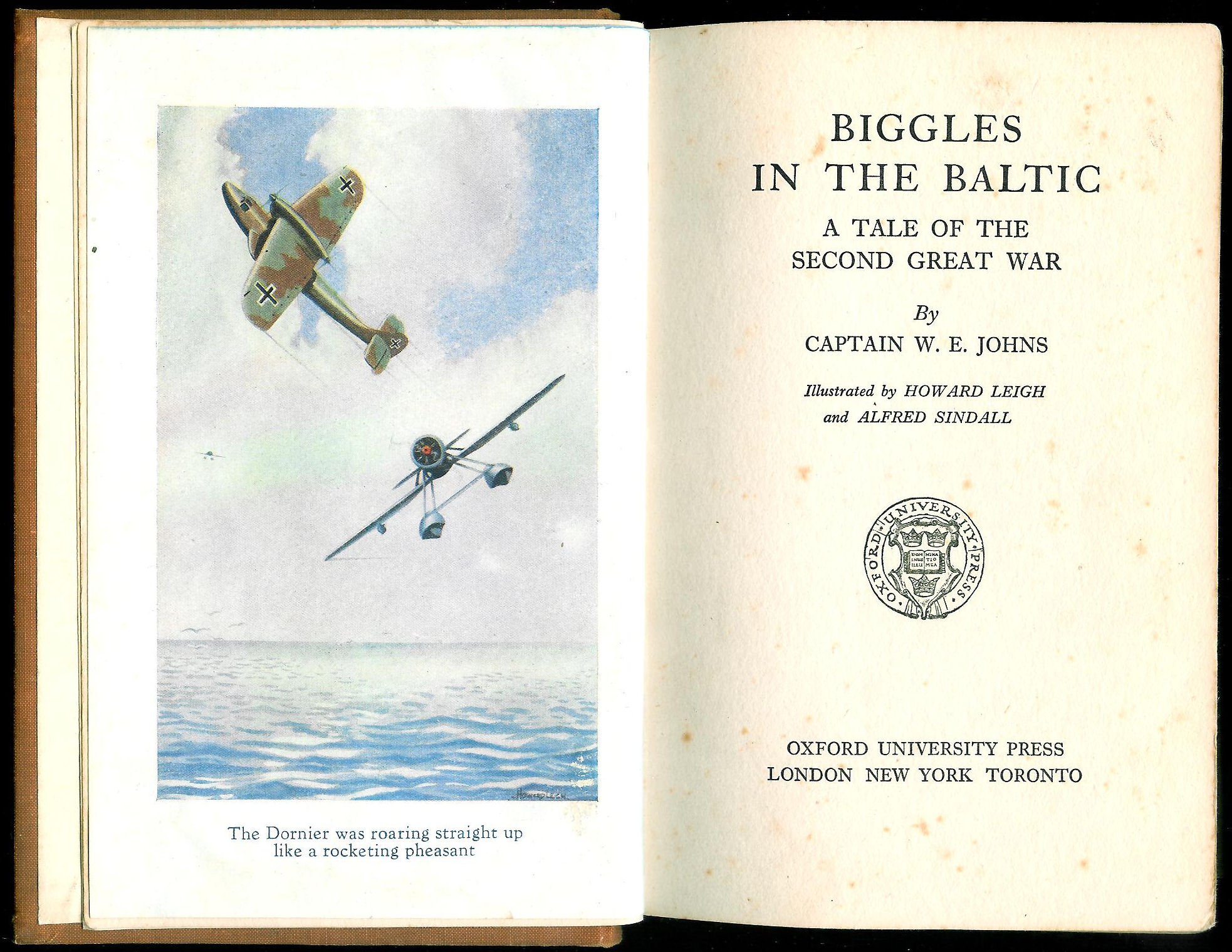
Frontispiece
Click on the above to see it in more detail